

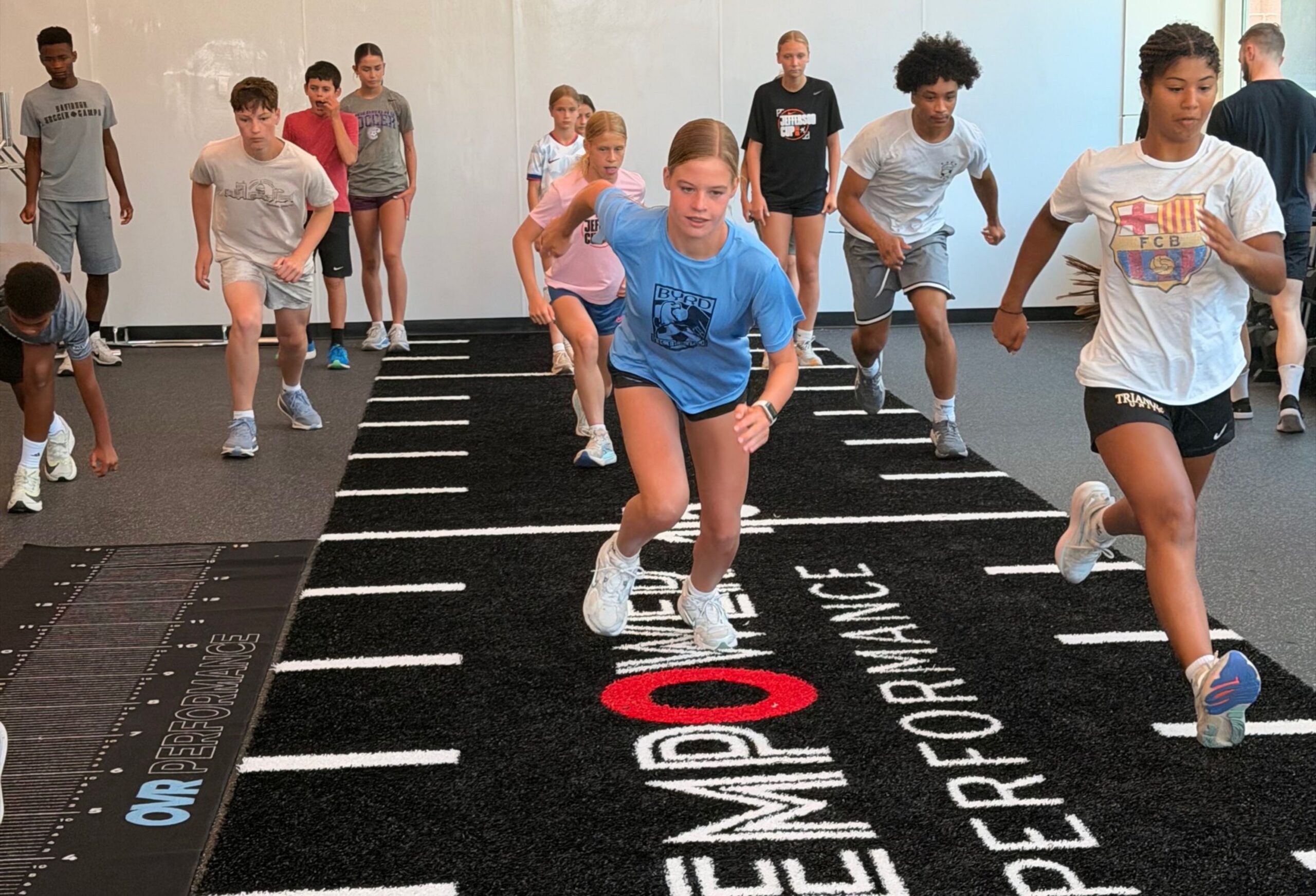
In youth sports, speed, agility, jumping ability, and explosive power often get the most attention. Coaches and athletes naturally gravitate toward the exciting parts of performance: sprinting faster, jumping higher, changing direction quickly, and making game-winning plays.
But there is an important part of athletic development that often gets overlooked: the ability to slow down, control the body, and produce force safely and efficiently.
Deceleration and basic strength are foundational components of athletic development. They help young athletes build the movement skills needed to perform confidently, respond to the demands of competition, and develop physically over time.
Before we focus on how fast an athlete can move, we should consider how well they can control that movement.
1. Deceleration: The Missing Piece in Athletic Development
Deceleration is the ability to reduce speed, absorb force, and bring the body under control. It happens constantly in sports, whether an athlete is stopping after a sprint, landing from a jump, cutting to avoid a defender, or changing direction to pursue a ball.
While acceleration helps an athlete create speed, deceleration allows them to manage that speed.
Think about a basketball player driving toward the basket before stopping to change direction. Consider a soccer player sprinting to close down an opponent before planting a foot and moving laterally. Or picture a baseball player slowing down after running through first base.
Each situation requires the athlete to absorb and redirect force while maintaining control of their body.
You cannot consistently change direction efficiently if you cannot first control your momentum.
For youth athletes, learning to decelerate effectively means developing the ability to:
- Maintain balance while slowing down.
- Coordinate the hips, knees, and ankles during stopping and landing.
- Control the trunk and pelvis during changes in direction.
- Distribute forces across the body rather than relying excessively on one joint.
- Recognize appropriate body positions when preparing to stop, land, or redirect movement.
These skills are not developed overnight. They require intentional practice, repetition, and coaching that prioritizes movement quality before increasing speed or complexity.
2. Why Deceleration Matters for Injury Risk
Youth athletes are still developing their strength, coordination, balance, and body awareness. During periods of rapid growth, changes in limb length and body proportions can temporarily affect coordination and movement control.
Add the demands of competition high speeds, unpredictable opponents, fatigue, and repeated changes of direction and the importance of force control becomes even clearer.
Poorly controlled landings, abrupt stopping strategies, and inefficient cutting mechanics can increase the demands placed on the muscles and joints. Developing better deceleration skills may help athletes manage these demands more effectively.
This does not mean that every athlete who struggles to stop is destined to get injured, or that deceleration training alone can prevent injuries. Sports injuries are multifactorial. However, training athletes to absorb force, maintain control, and respond to movement demands is a valuable part of a comprehensive injury-risk-reduction strategy.
The goal is not to eliminate force from sport. That is impossible.
The goal is to prepare young athletes to manage force.
What does deceleration training look like?
It does not need to be complicated. In fact, the best starting point is often simple.
Examples include:
- Snap-downs: Teaching athletes to move from an upright position into a balanced athletic stance.
- Jump-and-stick landings: Practicing controlled landings with a brief, stable hold.
- Short sprint-to-stop drills: Building the ability to slow down over an appropriate distance.
- Lateral shuffle-to-stop drills: Developing control during side-to-side movement.
- Planned change-of-direction drills: Teaching athletes to brake, plant, and redirect before adding reactive decision-making.
Start at manageable speeds and distances. Emphasize balance, posture, and control. As athletes demonstrate consistent technique, gradually increase speed, distance, complexity, and unpredictability.
The objective is not simply to make a drill harder. It is to help the athlete develop the capacity to handle greater demands.
3. Basic Strength: The Foundation of Athletic Movement
Strength is another essential component of youth athletic development, yet it is sometimes misunderstood.
Strength training for young athletes does not have to mean lifting maximal weights or following a highly specialized bodybuilding program. It means developing the ability to produce and control force through appropriate movement patterns.
A well-designed youth strength program can include bodyweight exercises, resistance bands, medicine balls, dumbbells, barbells, and other age-appropriate equipment. The equipment matters less than the quality of instruction, appropriate progression, and consistency of training.
Basic strength helps support the movement skills athletes use every day.
Consider a few examples:
- Squatting: Develops lower-body strength used in jumping, landing, and athletic positions.
- Hinging: Builds strength through the hips and posterior chain, supporting sprinting and force production.
- Lunging and split squatting: Develop unilateral strength and control that can transfer to running, cutting, and single-leg tasks.
- Pushing and pulling: Build upper-body strength and support whole-body coordination.
- Bracing and trunk-control exercises: Help athletes manage body position while producing or absorbing force.
- Calf and ankle strengthening: Develop capacity in muscles involved in running, jumping, and landing.
These patterns do not need to look perfect from day one. Youth athletes have different experience levels, coordination abilities, and physical needs. The goal is to teach them to move well, build confidence, and progressively develop strength.
Strength is more than lifting weights
Basic strength also helps athletes improve their ability to tolerate training demands. Stronger muscles can contribute to force absorption and joint control, while improved coordination helps athletes use that strength effectively.
That is why strength training should complement, rather than replace, running, jumping, landing, and change-of-direction practice.
4. The Connection Between Strength and Deceleration
Strength and deceleration are closely connected.
When an athlete sprints at high speed and suddenly needs to stop, the body must absorb substantial forces in a short period. Muscles need to produce force while lengthening, joints must move through appropriate ranges, and the athlete must coordinate their body position to maintain balance.
This requires more than quick feet. It requires physical capacity and motor control.
An athlete with limited lower-body strength may struggle to control deeper braking positions. An athlete with poor trunk control may have difficulty maintaining a stable body position during a sharp cut. An athlete who has never practiced landing or stopping may lack the coordination needed to manage these tasks efficiently.
Of course, no single strength exercise guarantees better deceleration. The transfer comes from combining foundational strength with specific movement practice.
A simple progression might look like this:
- Build the positions. Teach an athletic stance, basic squat and hinge patterns, and controlled landing mechanics.
- Develop strength. Introduce age-appropriate resistance exercises that reinforce these patterns.
- Practice absorbing force. Use controlled landings, low-level hops, and short stopping drills.
- Introduce movement speed. Progress to faster accelerations followed by planned deceleration.
- Add decision-making. Once the athlete demonstrates adequate control, introduce reactive drills that require responding to a visual or verbal cue.
5. Movement Quality Before Complexity
One common mistake in youth athletic development is progressing to advanced drills before an athlete has developed the necessary foundation.
Complex agility ladders, rapid cone drills, reactive challenges, and high-speed cutting exercises can be engaging. But if an athlete cannot maintain balance during a simple landing or control their body during a basic stop, adding complexity may reinforce inefficient strategies rather than improve them.
This does not mean youth athletes should avoid challenging exercises. They need opportunities to explore, react, compete, and develop athletic skills.
It means that the difficulty of the drill should match the athlete’s current ability, not simply their age or competitive level.
Quality movement is not about forcing every athlete into one ideal-looking position. Bodies differ, and movement strategies vary by task. Coaches should focus on appropriate control, repeatability, and the athlete’s ability to meet the demands of the activity.
6. A Practical Example: Building a Foundation in One Session
A youth athletic development session can incorporate strength and deceleration without requiring complicated equipment or hours of training.
Here is one example of a general session for athletes who have been appropriately screened for participation and are supervised by a qualified coach.
Sample foundational session
Part 1: Movement preparation
- Dynamic warm-up and light running.
- Controlled skips, marches, and lateral movements.
- Basic athletic stance and balance practice.
Part 2: Strength development
- Bodyweight squat or goblet squat.
- Hip hinge variation.
- Split squat or supported lunge.
- Push-up variation.
- Row variation.
- Calf raises and simple trunk-control exercises.
Part 3: Deceleration and landing
- Snap-downs with a balanced finish.
- Low-intensity jump-and-stick landings.
- Short acceleration followed by a controlled stop.
- Lateral movement followed by a balanced stopping position.
Part 4: Athletic application
- Planned change-of-direction drills.
- Short, controlled competitive movement games.
- Sport-specific movement practice when appropriate.
7. Long-Term Athletic Development Over Short-Term Results
Youth sports can create pressure to specialize early, compete constantly, and prioritize immediate performance. But developing a better athlete is a long-term process.
Young athletes benefit from learning fundamental movement skills, developing strength, exploring different movement challenges, and building confidence in their physical abilities.
Deceleration and strength training support this process because they teach athletes how to control their bodies—not just how to perform a single skill.
A stronger athlete is not necessarily a better athlete in every situation. A faster athlete is not automatically more prepared for the demands of competition. And a technically impressive drill does not always translate into effective movement during a game.
The real objective is to develop athletes who can produce force, absorb force, change direction, and adapt to unpredictable situations.
That requires patience and a progression that respects each athlete’s development.
Coaches should celebrate improvements in control, balance, consistency, and confidence just as much as improvements in sprint times or vertical jump height.
These qualities may be less exciting to measure on a scoreboard, but they are important building blocks for future performance.
Conclusion: Teach Athletes to Stop Before Asking Them to Go Faster
Speed and explosiveness are valuable qualities in sport, but they are only part of the picture.
Young athletes must also learn how to control their momentum, absorb force, and maintain effective movement positions. Deceleration training develops these abilities through purposeful stopping, landing, and change-of-direction practice. Basic strength training builds the physical capacity that helps support those movements.
Together, they create a foundation for more effective athletic development.
Instead of asking only, “How fast can this athlete run?” or “How high can this athlete jump?” we should also ask:
- Can they land and maintain control?
- Can they slow down without losing balance?
- Can they change direction with an appropriate movement strategy?
- Do they have the strength to support the demands of their sport?
- Can they repeat these skills consistently as the challenge increases?
These questions encourage a more complete approach to training.
Build strength. Teach control. Develop deceleration. Then progressively challenge speed and complexity.
When we invest in the fundamentals, we give young athletes a better opportunity to develop into capable, confident, and well-prepared movers both now and as they progress in sport.
Team Empower